
How AI Is Changing Robotics: A Review of the Best AI-Powered Robots
Computer vision, neural networks, NLP, reinforcement learning. NavBot, Petoi, DEEPRobotics Lite3, Unitree H1.
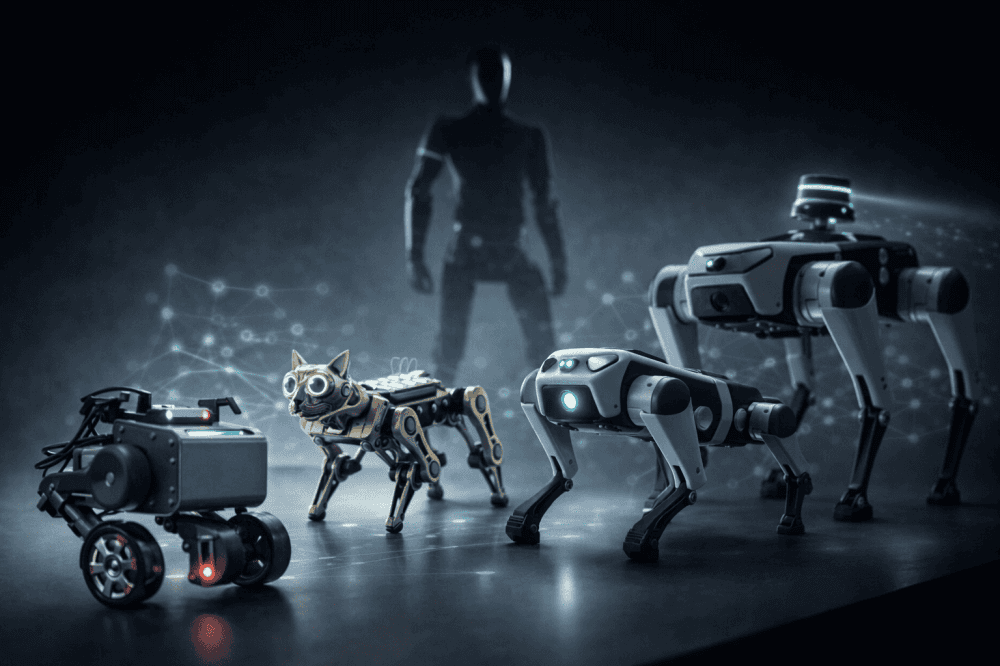
Classical robotics relied on rigidly defined scenarios: a device performed the same set of actions in a controlled environment. The emergence of artificial intelligence models has changed the approach: robots now perceive the world through cameras and sensors, analyze data, and adapt to changes in their environment.
Key AI Technologies in Robotics
Computer Vision and Pattern Recognition
A set of algorithms that transform camera images into structured information: where a person is, where an obstacle is, and what object is in the frame. They allow robots to recognize markings, estimate distances, and understand basic gestures.
Deep Learning and Neural Networks
Multi-layer neural networks learn from large datasets: they train models for stable walking on complex terrain, recognize dozens of object types, and predict the movement of people and vehicles nearby.
Natural Language Processing
The user formulates a task in natural language, and the robot interprets the request and launches the appropriate scenario. In service scenarios: greeting visitors, voice navigation, and answering common questions.
Adaptive Control and Reinforcement Learning
The agent explores different actions and receives a 'reward' for successful outcomes. The robot gradually adapts its trajectory to real conditions, learns to avoid dangerous situations, and optimizes energy efficiency.
Top Popular AI Robots
Unitree H1 Basic — a humanoid robot ~180 cm tall, up to 3.3 m/s, LiDAR and cameras, for shows, R&D, and educational setups. DEEPRobotics Lite3 Venture — a quadruped platform for events, perimeter patrol, and facility inspection.
| Model | Type | AI Capabilities | Scenarios |
|---|---|---|---|
| Unitree H1 Basic | Humanoid | Motion planning, LiDAR and camera data processing | Shows, R&D, training courses |
| DEEPRobotics Lite3 | Quadruped | Autonomous walking, sensor integration | Perimeter patrol, demonstrations |
| Petoi Bittle R | Mini robot dog | Stable walking, AI camera integration | Robotics courses, exhibitions |
The Future of AI Robots: Trends Through 2030
Quantum computing will accelerate route optimization and data processing. Advances in tactile sensors will enable robots to more precisely dose force and distinguish object textures. Micro-robot swarm coordination will open new possibilities for inspecting complex structures.
Получите расчёт под вашу задачу
Цена зависит от конфигурации и комплектации. Инженер Alashed соберёт КП и предложит подходящую модель Unitree за 30 минут.