
Industrial Robots in Manufacturing: Types, Applications, and Implementation Approach
Manipulators, delta, SCARA, cobots. Welding, assembly, palletizing. ABB, KUKA, Fanuc, Universal Robots.
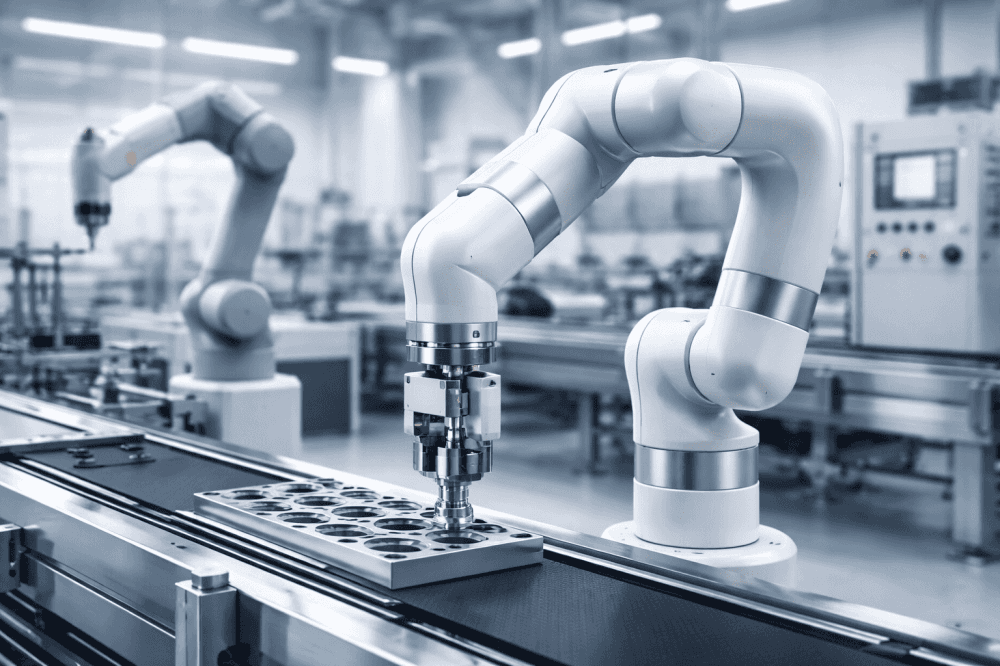
In most production automation projects, robots become part of manufacturing systems where conveyors, sensors, grippers, safety systems, and software work side by side. The same robot can perform different roles: moving products, tending machines, or precisely positioning a part before processing.
How Are Robots Changing Modern Factories?
Robots take over routine, repetitive tasks from humans, as well as operations in zones with hazardous conditions — dust, fumes, and high temperatures. In practice, this translates to more consistent cycle times, lower defect rates, and the ability to plan equipment utilization.
Main Types of Industrial Robots
Articulated Manipulators
Six-axis manipulators are a universal class for welding, machine tending, part assembly, and palletizing. Manipulators work well when flexibility and diverse trajectories are needed: reaching into tight spaces, navigating around obstacles, and executing complex arcs.
Delta Robots
The delta configuration is used when rapid handling of lightweight objects is required: sorting, placing, and dosing. These robots are common in packaging, food processing lines, and electronics.
SCARA Robots
SCARA mechanics are well suited for planar trajectories and precision work in assembly zones. They are typically chosen for operations with repeating positions: component insertion, screw driving, and adhesive dispensing.
Collaborative Robots
Collaborative solutions are used when working alongside an operator, frequent changeovers, and a compact cell are needed. They are suitable for low-volume production runs, laboratories, and phased automation.
Industrial Robot Application Areas
Automotive: body welding, sealing, painting. Electronics: precision assembly, SCARA and delta. Food industry: placing, sorting, packaging. Pharmaceuticals: repeatability, quality control. Metalworking: workpiece loading, machine tending.
Automation Technologies
Robotic welding and soldering, automated assembly and installation, painting and coating, quality control and inspection, packaging and palletizing — all of these areas are being actively automated.
How to Choose an Industrial Robot?
It is best to start with the process, not the model: describe operations and quality requirements, assess the environment, define the architecture, plan safety measures, run a pilot and collect data, and establish operating and maintenance procedures.
Получите расчёт под вашу задачу
Цена зависит от конфигурации и комплектации. Инженер Alashed соберёт КП и предложит подходящую модель Unitree за 30 минут.